Every mutual fund investor in India eventually runs into this fork in the road: Direct Plan or Regular Plan. The name on your statement looks like a minor technical detail. It isn’t. Over two decades, that one word can decide whether you retire with ₹88 lakh or ₹73 lakh on the exact same fund.
This isn’t a “which is better” opinion piece. It’s a walkthrough of what the two plans actually are, where the cost hides, and what the gap looks like once you run the compounding math honestly — with the assumptions shown, not hidden.
Scheme and Product Basics: What You’re Actually Buying
Before comparing costs, it helps to be precise about what a “scheme” is. A mutual fund scheme is a pooled investment product — thousands of investors’ money managed by one fund manager, following one stated objective (say, large-cap equity, or short-duration debt). When you invest, you’re buying units of that pool at the current Net Asset Value, or NAV.
Since January 2013, SEBI has required every mutual fund scheme in India to be sold in two parallel versions:
| Feature | Direct Plan | Regular Plan |
|---|---|---|
| Bought through | AMC website, MF Central, or direct app | Distributor, bank RM, or advisor |
| Underlying portfolio | Identical | Identical |
| Fund manager | Same person | Same person |
| Investment objective | Same | Same |
| Distributor commission | None | Built into the expense ratio |
| Expense ratio | Lower | Higher |
| NAV | Higher (same fund, lower cost) | Lower |
| Advisory support | None — self-directed | Included |
| SEBI mandate | Introduced 2013 | Introduced 2013 |
Here’s the part that surprises first-time investors: a Direct and Regular plan of the same scheme are not two different funds. They hold the same stocks or bonds, follow the same strategy, and are run by the same fund manager. The portfolio is identical down to the rupee. The only thing that differs is the fee structure — and consequently, the NAV.
That fee structure is called the Total Expense Ratio (TER) — an annual percentage charged on your investment to cover fund management, operations, and (in the Regular plan’s case) distributor commission. It’s deducted daily from the fund’s assets before the NAV is published, so you never see it as a separate debit. That’s exactly why most investors underestimate it — it’s invisible in your statement, but not invisible in your final corpus.
Direct Plan vs Regular Plan: Where the Money Actually Goes
In a Regular plan, part of your annual expense ratio is paid out as a distributor’s commission — an upfront cut plus an ongoing “trail” commission for as long as you stay invested. This is standard, disclosed industry practice, not a hidden fee, but it’s rarely explained in those terms at the point of sale.
Typical expense ratio gaps across fund categories, based on data compiled across AMC scheme documents and industry commentary in 2026:
| Fund Category | Typical Direct Plan TER | Typical Regular Plan TER | Approximate Gap |
|---|---|---|---|
| Active large-cap equity | 0.6% – 1.0% | 1.6% – 2.2% | ~1.0% |
| Active flexi-cap / multi-cap equity | 0.6% – 1.1% | 1.8% – 2.4% | ~1.1% |
| Small-cap / mid-cap equity | 0.7% – 1.2% | 1.9% – 2.4% | ~1.0% – 1.2% |
| Index funds (Nifty 50 / Sensex) | 0.1% – 0.3% | 0.3% – 0.6% | ~0.15% – 0.3% |
| Debt funds (short duration) | 0.2% – 0.5% | 0.7% – 1.2% | ~0.5% |
| Hybrid / balanced advantage | 0.4% – 0.9% | 1.4% – 2.0% | ~1.0% |
A few honest caveats belong right here. First, these are ranges, not fixed numbers — TER varies by AMC and by the size of the scheme (larger schemes get lower TER slabs under SEBI’s tiered structure). Second, index funds show the smallest gap, because there’s little “advice” being sold on a fund that just tracks an index — the commission opportunity is thinner to begin with. Third, TER can and does change year to year; always check the latest Scheme Information Document rather than assuming last year’s number holds.
The Real Cost Over 20 Years: Running the Actual Numbers
This is where most articles wave their hands and say “it adds up.” Let’s not do that. Below is the actual compounding math, with assumptions stated upfront so you can adjust them for your own fund.
Assumptions used:
- Gross fund return (before expenses): 12% per annum — a reasonable long-term assumption for diversified equity, not a guarantee
- Direct Plan expense ratio: 0.5% → net return 11.5%
- Regular Plan expense ratio: 1.5% → net return 10.5%
- No exit load, no taxes, no change in expense ratio over the period (a simplification — real funds vary)
Scenario 1: One-Time Lump Sum of ₹1,00,000
| Years Invested | Direct Plan Value | Regular Plan Value | Difference | Difference as % of Regular Value |
|---|---|---|---|---|
| 5 | ₹1,72,335 | ₹1,64,745 | ₹7,591 | 4.6% |
| 10 | ₹2,96,995 | ₹2,71,408 | ₹25,587 | 9.4% |
| 15 | ₹5,11,827 | ₹4,47,130 | ₹64,696 | 14.5% |
| 20 | ₹8,82,058 | ₹7,36,623 | ₹1,45,435 | 19.7% |
Notice the shape of that last column. The percentage gap doesn’t grow in a straight line — it accelerates. In year 5, the 1% annual fee difference has cost you 4.6% of your corpus. By year 20, it has quietly eaten almost 20% of what the Regular plan investor ends up with. That’s compounding working against you, in exactly the same way it works for you when you start early.
Scenario 2: Monthly SIP of ₹10,000
This is closer to how most Indian retail investors actually build wealth — steady monthly contributions rather than a single lump sum.
| Years Invested | Amount Invested | Direct Plan Corpus | Regular Plan Corpus | Difference |
|---|---|---|---|---|
| 5 | ₹6,00,000 | ₹8,13,572 | ₹7,91,555 | ₹22,017 |
| 10 | ₹12,00,000 | ₹22,55,442 | ₹21,26,594 | ₹1,28,848 |
| 15 | ₹18,00,000 | ₹48,10,828 | ₹43,78,276 | ₹4,32,552 |
| 20 | ₹24,00,000 | ₹93,39,666 | ₹81,75,968 | ₹11,63,698 |
Read that last row carefully. On a total invested amount of ₹24 lakh over 20 years, the choice of Direct over Regular is worth roughly ₹11.6 lakh — money that came from nowhere except a lower expense ratio compounding quietly, month after month, for two decades. That’s not a return you earned by picking a better fund. It’s a return you kept simply by not paying for a service you may not have used.
What the Growth Actually Looks Like
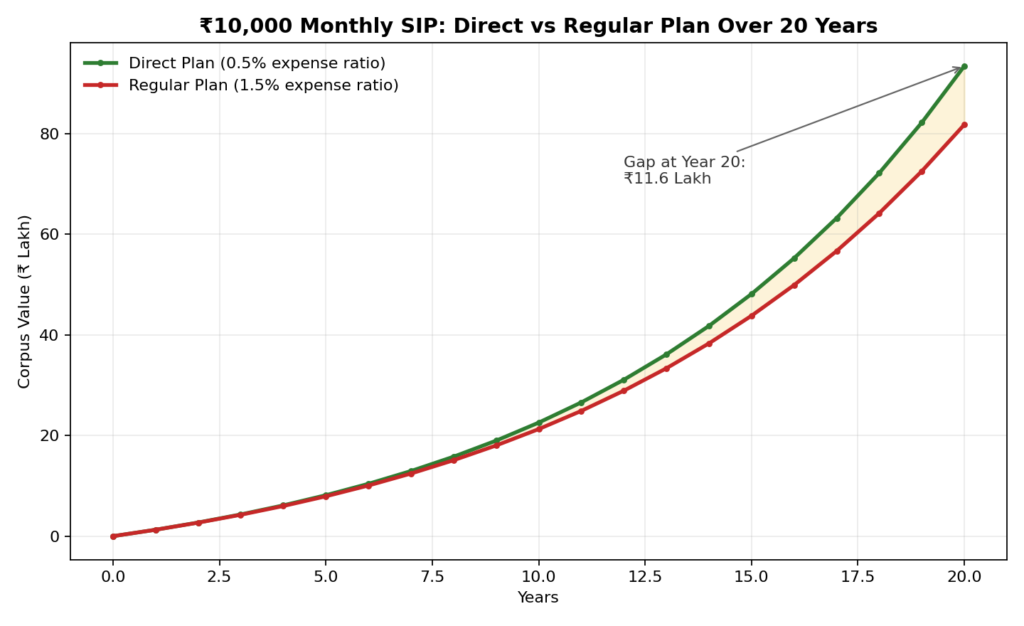
The two lines sit close together for the first several years — the gap is barely visible at year 3 or 4. It’s only in the second decade that the curves visibly separate, which is exactly why the cost of a Regular plan feels invisible in the short run and only becomes obvious in hindsight, usually right around retirement or goal maturity — the point where it’s too late to do anything about the years already gone.
Why Regular Plans Still Exist — and Who They’re Actually For
It would be easy to conclude every rational investor should pick Direct and move on. The data doesn’t support quite that clean a conclusion, and it’s worth being honest about why.
A Regular plan bundles in a distributor’s ongoing service — fund selection help, portfolio reviews, rebalancing reminders, and behavioural support during market crashes (arguably the single most valuable thing an advisor provides, since panic-selling during a downturn tends to cost investors far more than 1% a year). For someone who would otherwise leave a SIP running into an underperforming fund for a decade, or stop SIPs altogether during a correction, that advisory relationship can be worth more than the fee gap shown above.
Industry AUM data reflects this trade-off playing out in real time. Individual investors’ assets in direct plans grew roughly 43% in 2025, well ahead of the 11% growth seen in regular plans, according to AMFI data cited by Business Standard. Even so, regular plans continue to hold the larger share of total industry assets, because a meaningful share of investors weigh the guidance and hand-holding above the pure cost savings.
So the honest framing is this: Direct plans are structurally cheaper, and cheaper compounds into a large number over 20 years. Whether that’s the right choice for you depends on whether you’ll actually do the fund selection, rebalancing, and — critically — the not-panicking yourself, or whether you value paying for someone else to hold that responsibility.
How to Switch from Regular to Direct (If You Decide To)
If the numbers above make you want to move existing investments, a few practical points matter:
1. Switching is treated as a redemption plus a fresh purchase for tax purposes. If you’ve held equity fund units for less than a year, switching can trigger short-term capital gains tax. Held over a year, it’s long-term gains, taxed accordingly — check current LTCG rules before switching.
2. Exit loads may apply if you switch within the load period specified in the scheme document (commonly 1 year for equity funds, but this varies).
3. New SIPs can simply be started fresh in the Direct plan without touching the existing Regular plan holdings — many investors choose this middle path rather than triggering a taxable event on old investments.
4. The switch itself is done through the AMC or MF Central, not through your existing distributor, since you’re moving away from that relationship.
None of this is a recommendation to switch — only a note on the mechanics, because the tax and exit-load cost of switching needs to be weighed against the expense-ratio savings calculated above, especially for money already close to its goal date.
The Honest Caveats
A few things this analysis deliberately does not claim:
- **12% is an assumption, not a guarantee.** Equity markets don’t return a smooth 12% every year — some years are +25%, some are -15%. The table above shows the effect of the *fee difference in isolation*, holding the return assumption constant for both plans, which is the correct way to isolate the cost impact. It is not a return forecast.
- **The 1% expense ratio gap is illustrative, not universal.** As the category table above shows, index funds carry a far smaller Direct-Regular gap than active equity funds. Check your specific scheme’s factsheet for its actual TER.
- **This ignores taxes, exit loads, and the value of advice** — all of which are real and can change the practical outcome for any individual investor.
- **Past performance and past expense ratios don’t guarantee future ones.** TER can be revised by the AMC, subject to SEBI’s regulatory caps.
A Closer Look: Why the Gap Accelerates in the Second Decade
It’s worth pausing on one thing the tables above make visible but don’t explain: why does a flat 1% annual fee gap turn into a 20% difference in final corpus, rather than a 20% difference spread evenly across all 20 years?
The answer is that expense ratio doesn’t just cost you the fee itself — it costs you the returns that fee would have generated had it stayed invested. In year 1, a 1% fee on ₹1,00,000 is ₹1,000. But that ₹1,000, left invested, would have grown for 19 more years. By year 20, the fee taken in year 1 alone has cost you far more than ₹1,000 in foregone growth. Every year’s fee compounds against you in exactly the same way your returns compound for you. This is the same mathematical principle that makes starting a SIP five years earlier worth so much more than five extra years of contributions — time is doing more of the work than the money itself, in both directions.
This is also why the percentage gap in the lump sum table barely moves between year 1 and year 5 (roughly 1–5%) but nearly quadruples between year 10 and year 20 (9.4% to 19.7%). Compounding costs, like compounding returns, are backloaded.
Frequently Asked Questions
Is a Direct plan riskier than a Regular plan?
No. Risk comes entirely from the underlying portfolio — the stocks or bonds the fund holds — which is identical in both plans. The Direct plan is not a different fund with different risk; it’s the same fund bought without a commission-paying intermediary.
Can I hold both Direct and Regular units of the same fund?
Yes. They’re technically treated as two separate options under the same scheme, and many investors end up holding both — older units in Regular (bought through a distributor years ago) and newer SIPs in Direct.
Does the fund manager treat Direct plan investors differently?
No. The fund manager runs one portfolio for the entire scheme. Direct and Regular plan investors get proportionally identical exposure to that portfolio; only the fee taken out before the NAV is calculated differs.
Will my returns definitely be higher in a Direct plan?
Your gross returns (before fees) will be identical, since it’s the same fund. Your net returns (after fees) will be higher in the Direct plan by roughly the size of the expense ratio gap, compounded over your holding period — this part is close to guaranteed, since it’s a function of the fee structure rather than market performance.
How do I check the exact expense ratio of my fund?
The Scheme Information Document (SID) and monthly factsheet, published on the AMC’s website and on AMFI’s portal, list the current TER for both Direct and Regular plans of every scheme. This is the number to check rather than relying on category averages like the ones in this article.
The Takeaway
The Direct vs Regular decision isn’t really about which plan is “better” in the abstract — it’s about correctly pricing what you’re paying for. A 1% annual expense ratio gap sounds trivial on a monthly statement. Run through two decades of compounding, on the same ₹10,000 SIP, and it’s the difference between a corpus of ₹93 lakh and ₹82 lakh — over ₹11.6 lakh that either stayed in your pocket or paid for a service you did or didn’t use.
If you’re comfortable doing your own fund research, rebalancing without hand-holding, and — most importantly — staying invested through a crash without calling anyone for reassurance, the Direct plan’s math is hard to argue with. If you know you need that phone call during a 20% drawdown, the Regular plan’s cost may be buying you something the spreadsheet above can’t price in.
*This article is for educational purposes only and does not constitute investment advice. Mutual fund investments are subject to market risk. The figures shown are illustrative projections based on stated assumptions and do not represent guaranteed or actual fund performance. Please read scheme-related documents carefully and consult a SEBI-registered investment adviser before making investment decisions.*